Skip to content
The baroque west facade of the Cathedral of Santa María in Murcia, carved in golden stone

Región de Murcia · 37.98° N

A city carved in warm stone and sunlight.

Where the Segura river slows and the orchard begins, Murcia keeps a baroque cathedral, a gilded social palace, and a table built from its own famously fertile plain. This is the unhurried south of Spain.

The lay of the land

The seventh-largest city in Spain, and one of its most overlooked.

Founded by the emir Abd al-Rahman II in 825, Murcia grew rich on the silk and citrus of its huerta, the irrigated plain that still feeds the region. Moorish waterworks, a Christian cathedral, and a nineteenth-century bourgeoisie left a city that wears every layer at once, low, golden, and easy to walk in a morning.

Cathedral begun
1394
Cathedral begun
Bell tower height
95m
Bell tower height
Days of sun a year
300+
Days of sun a year
Oldest urban core
C7
Oldest urban core
01Architecture

Stone that tells four centuries in one square.

Murcia's monuments stand within a few streets of one another, so the city reads like a single, slow-built room.

Carved baroque facade of Murcia Cathedral with sculpted saints and columns

1394 - 1792

Cathedral of Santa María

The Imafronte, the cathedral's main face, is one of the great works of the Spanish Baroque, a wall of sculpted saints and twisting columns finished by Jaime Bort in 1754. Inside, a Gothic nave gives way to the Vélez Chapel and a bell tower you can still climb for the whole plain.

  • Baroque
  • Gothic
  • Climbable tower
The ornate eclectic facade of the Real Casino de Murcia

1847

Real Casino de Murcia

Not a gambling hall but a social club, the Casino is a museum of nineteenth-century taste: a Moorish patio modelled on the Alhambra, a ladies' powder room with a painted ceiling of Selene, a library of twenty thousand volumes, and a ballroom dripping with gold leaf and gas-lit chandeliers.

  • Eclectic
  • Moorish revival
  • Open to visit
The Moorish-revival Patio Árabe inside the Real Casino de Murcia, with horseshoe arches and gilded stucco
The Patio Árabe of the Real Casino, plaster carved and gilded in homage to Granada's Alhambra.
02Culture & lifestyle

A calendar lived outdoors, between processions and the orchard.

Murcianos measure the year in fiestas. Lent ends not with quiet but with a fortnight of spring celebration, and the rest of the calendar fills with markets, terrace dinners that start late, and the slow social hour the city calls la tarde.

A baroque processional float by sculptor Francisco Salzillo carried through Murcia during Holy Week

Holy Week · March or April

Semana Santa

Murcia's Holy Week is famous for the carved processional figures of Francisco Salzillo, the eighteenth-century sculptor whose tableaux of polychrome wood are paraded at dawn on Good Friday by the Cofradía de Jesús.

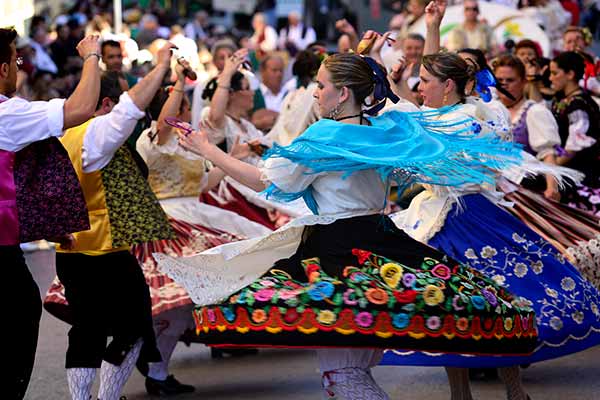
Families in traditional huertano peasant dress during the Bando de la Huerta festival in Murcia

Tuesday after Easter

Bando de la Huerta

The whole city dresses as huertanos, the orchard farmers of old, fills the streets with barracas serving regional food and wine, and turns the day into Murcia's loudest, warmest celebration of itself.

“Murcia es huerta, agua y sol.”

A local saying - orchard, water, and sun
03Gastronomy

A table built from the orchard out.

With one of Europe's most productive plains at its edge, Murcia cooks vegetables the way other cities cook meat - centre of the plate, never an afterthought.

A plate of paparajotes, fried lemon-leaf fritters dusted with cinnamon and sugar
Paparajotes, the city's signature sweet.
A bowl of pisto, slow-cooked peppers, tomato, onion and courgette in olive oil
Pisto murciano, the harvest stewed slow.
  • 01

    Paparajotes

    Dessert

    Lemon-tree leaves dipped in a sweet anise batter, fried, and dusted with cinnamon sugar. You eat the batter and leave the leaf, a trick worth knowing before your first one.

  • 02

    Pisto murciano

    Vegetable

    The huerta on a plate: peppers, tomato, onion and courgette slow-cooked in olive oil, often crowned with a fried egg. Murcia's answer to its own endless harvest.

  • 03

    Zarangollo

    Tapa

    Scrambled courgette, onion and egg, soft and gentle, served warm with bread as a midday tapa across the city's terraces.

  • 04

    Marinera

    Tapa

    A ring of breadstick crowned with Russian salad and a salted anchovy. Order it 'con bigote' for the anchovy, the unofficial emblem of a Murcian bar.

  • 05

    Michirones

    Stew

    Dried broad beans stewed long with chorizo, ham bone and a hit of pimentón, a hearty winter dish poured straight from the orchard's pantry.

  • 06

    Caldero

    Rice

    From the nearby Mar Menor lagoon: rice cooked in a copper pot with rock fish and dried ñora pepper, eaten in two courses with allioli.

04Travel tips

A short, honest guide for a first visit.

Murcia is small, sunny and unfussy. A weekend is enough to see it well; a few practical notes make it smoother.

When to go

Spring and autumn are golden, mild and dry. Summer pushes past 38°C, so locals move slowly and eat late. Time a trip around Easter for the festivals at their fullest.

Getting there

Región de Murcia airport (RMU) sits 25 minutes out; Alicante (ALC) is an hour by road with far more flights. High-speed AVE trains link the new Murcia del Carmen station to Madrid and Alicante.

Getting around

The historic centre is flat and walkable end to end in twenty minutes. A single tram line and cheap city buses cover the rest; you will not need a car within town.

Good to know

Lunch runs 2-4pm and dinner rarely starts before 9pm. Most monuments close midday. Tap water is safe, tipping is modest, and a café con leche still costs under two euros.

Colourful old buildings and café terraces around the Plaza de las Flores in Murcia's old town

Start at the Plaza de las Flores, coffee first, cathedral after.

Back to top